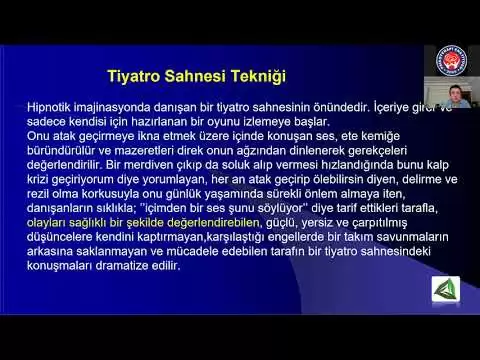
During a panic attack, our body secretes stress hormones that we call adrenaline and cortisol. When these hormones are released, most of those symptoms are actually produced by these hormones. Heart palpitations, shortness of breath, not being able to get enough breath, pulling in the hands and feet, dizziness, nausea, and these are all adrenaline symptoms. Because adrenaline constricts the vessels, there are also studies about the decrease in brain blood flow. During fear, a person cannot think rationally and becomes a captive of that fear. During adrenaline, in moments when we are afraid, our breathing accelerates, our heart starts beating very fast. Here, actually, we have a good control tool in our hands: breathing. When we start to slow down our breathing, when we breathe correctly and gradually slow our breath, at that moment the heart also slows down. And the person can get out of that panic attack in a short time. People who experience panic attacks, my observation and the studies show this, generally perfectionist, responsible, people who do every task and try to do it flawlessly, detail-oriented people who try to do more, to do perfectly, have these personality structures, these characteristics in the background. In the treatment of panic attacks, medications and various psychotherapy methods are used. I especially use hypnotherapy a lot together with psychotherapy. In the context of holistic psychotherapy, there are cognitive behavioral therapies, dynamic therapies, existential therapies, and I use a special method in which they are combined with hypnotic techniques. With hypnotherapy, I work on the person’s conscious personality structure, anxieties, old memories, what they feel during a panic attack, what is in the background of the emotions there. Then, under hypnotic trance, we teach the person how relaxed they were before the moment they had a panic attack, what they can do in that moment to relax quickly, and afterwards, with a technique we call self-hypnosis, with movements and signals they will use when they are going to experience a panic attack, we teach them to relax and loosen themselves. The person has some symptoms they feel before the panic attack comes. When they feel those symptoms, they do their self-hypnosis. There, they do the breathing techniques you taught, the breathing techniques. They slow their breathing. Generally, these panic attacks reach their maximum level in five to ten minutes, the distress, and usually pass in thirty minutes. The person, in hypnotic trance or in the psychotherapy process, for example, learns that the thoughts in their mind that do not work for them, like “I will die, I will faint, I will lose myself,” are actually not true, and when they display behaviors at that moment, by putting something different instead behaviorally by doing positive behaviors different from those avoidance behaviors, and by also working with unconscious processes in the background perhaps related to childhood, perhaps related to connections with mother and father figures, and when we reinforce this with self-hypnosis, it becomes a much more effective and permanent treatment. Only medication treatment suppresses the symptoms. But since it does not solve the background, I especially think it is necessary with psychotherapy and hypnotherapy. In this way, it can be a permanent and effective treatment. When the first attack first appears, it is really a very frightening situation. The person feels like they will die. Or that they will faint, lose control, and generally thinks they are having a heart attack. After examinations, they are directed to a psychotherapist, psychologist, doctor. In subsequent panic attacks, they try to take precautions not to face the same situation again. They show avoidance behaviors. At that moment, breathing slowing techniques. Breathing is very, very useful. For example, when you inhale for three units, hold your breath for three units, then start to exhale slowly in three units or in four or five units, you can start to take control. Because during a panic attack, adrenaline is secreted, so adrenaline is the fight or flight hormone. At that moment, the heart beats fast, breathing accelerates, some people hold their breath. Situations like dizziness, stomach cramps, pulling in the hands and feet occur. Adrenaline causes these. When we do the opposite of what adrenaline does, actually the best instrument is to slow down the breathing, and when we slow down the breathing, the heart also slows down. The person can close their eyes. At that moment, we can inhale for three seconds, hold for two seconds, and exhale slowly in five seconds. This, slowing down our breathing is very important. Inhaling for one or two seconds can be deep. Holding for two seconds and then exhaling slowly in four seconds, I recommend. As you slow down the breath, the heart will also slow down; when adrenaline is cleared from the blood, you will relax quickly. Also, if you add a positive suggestion to yourself while exhaling, for example “it’s passing, it’s passing” or “everything is fine, everything is fine.” If you say suggestions to yourself like “this is just a panic attack, it will pass after a short while,” you can relax much faster. I teach these techniques to people under hypnotic trance, under hypnosis. When a panic attack comes, I condition them to make a sign to it. And while exhaling their breath, “it’s passing, it’s passing. This is just a panic attack, it’s passing quickly. Everything is fine, everything is fine.” Or we find suggestions in this way that are suitable for the person. By slowing down the breath with these suggestions, with positive suggestions, and when we condition this suggestion, this word with the thing under hypnosis, it can pass much faster. Afterwards, the person also repeats the suggestions during the day when there is no attack, relaxing, and when an attack comes, they know what to do. After a while, since they already know that the attack will pass, their fears and anxieties decrease, their quality of life increases. When integrated with hypnotherapy and psychotherapy, much better results can be obtained.