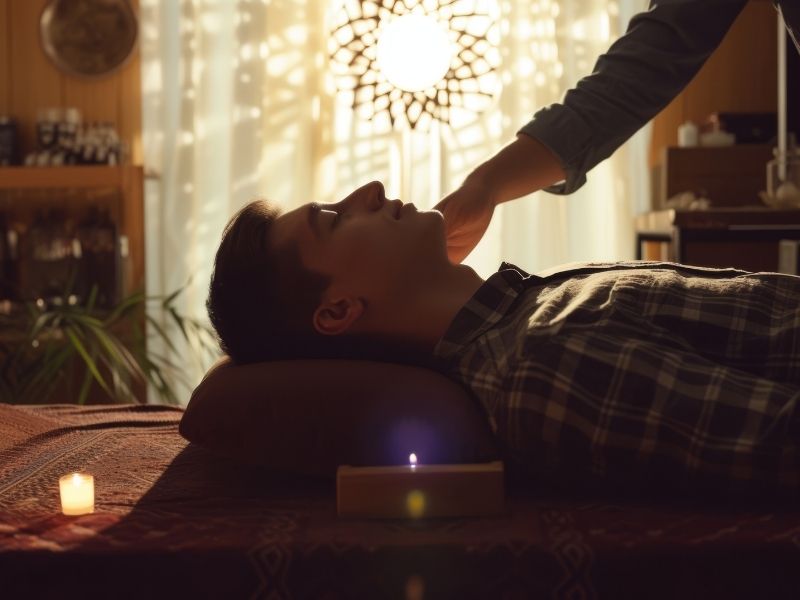
Hypnosis is a method carried out by placing a person into a certain state of absent-mindedness and trance while consciousness is open, aiming to overcome unconsciously suppressed issues and psychological problems. Hypnosis can be defined as a method that aims to resolve emotions, thoughts, behaviors, or habits that have settled in the patient’s subconscious without their awareness, through a special state of mental focus performed between sleep and wakefulness, at a stage where consciousness is fully open.
Hypnosis, which has been a dramatic treatment method attracting attention since the very first moments it began to be used in history, appears before us as a set of techniques. It is a psychic state that occurs by will, in which brain functions are actively working.
What Are the Characteristics of Hypnosis?
In fact, in order to better understand what hypnosis is, which is a normal and ordinary method that has been practiced for centuries, we can list its basic characteristics as follows;
- Hypnosis is a method that enables a return to elements experienced in the past and that have an unconscious effect on our behaviors.
- In hypnosis application, a person’s subconscious can become open to suggestion and can be guided in line with the person’s own will.
- Hypnosis is definitely not a sleep process. During hypnosis application, brain functions are active, individual control is open, and there is no state of sleep in the person. Therefore, the person does not lose control.
- Contrary to common belief, hypnosis does not make a person carry out everything said to them without questioning.
- During hypnosis, both hemispheres of the brain cooperate in a single area, but rather than the left brain, the right brain takes more control.
Hypnosis is basically a method in which behaviors, thoughts, or habits embedded in the patient’s subconscious are addressed in the active conscious state of the subconscious between sleep and wakefulness.
How Is Hypnosis Treatment Applied?
Hypnosis treatment method can be used successfully especially in the treatment of anxious conditions. Hypnosis is a highly effective method in reducing sensitivities in a person and preventing retriggering. With the hypnosis method applied in the fields of medicine and psychology, many conditions can be diagnosed or treated.
Hypnosis is applied for changing emotions, thoughts, situations that have become habits, or learned conditions that have settled unconsciously in a person. In this respect, hypnosis treatment can be applied in almost all problems described as psychological. In physical health problems, hypnosis treatment can be applied as an auxiliary treatment method to support the main treatment.
Phobias and Hypnosis
At the root of almost all known phobias, there are generally traumatic situations experienced in the past. The person makes the situation recorded in isolation with the moment of trauma closed to learning and codes it as an element that triggers fear.
Hypnosis treatment is an application that enables access to and therefore resolution of elements learned unconsciously in a person or transformed into habits. With hypnosis treatment, in the state created in the person between sleep and wakefulness, suggestions can be applied and guidance can be carried out to subconscious processes in line with the person’s own will. Phobias that have been coded in isolation and whose roots contain trauma from the past can be treated with the hypnosis method.
Panic Attack and Hypnosis
Panic attack can be described as intensely experienced fear attacks. Panic attack is a rapid increase in the level of anxiety and fear. The intense fear and anxiety attacks that occur are triggered by unconscious elements.
With hypnosis treatment, the necessary suggestions to unconsciously recorded elements can be carried out by the person with their own will, and memories, perceptions, and fears can be resolved.
Eating Disorders and Hypnosis
Eating disorders are basically the expression, through body perception, of the problems a person experiences in their inner world. The person tries to express the spiritual unrest or problems they experience through interventions they perform on their own body.
Hypnosis is an inward-turning treatment. Hypnosis treatment is applied in the resolution of elements from the past whose effects we continue in our emotions, behaviors, or habits without being aware of it. By reaching the source of the spiritual problems experienced by the person, attempts that may create negative consequences toward the person’s own body can be prevented or changed.
Stress and Hypnosis
Stress, which appears as one of the most frequently observed and most important illnesses of today and the new world conditions, is based on anxiety and fear.
Stress treatment through hypnosis application is carried out in 3 stages. In the first stage, illnesses caused by stress are treated; in the second stage, it is aimed to change behaviors developed against the factors causing stress; and in the final stage, the negative effects of the stress factor in the long term are prevented.

Addictions and Hypnosis
Addictions can be characterized as an illness with the negative effects they create in a person’s life, especially in social life. In addition, addictive substances can cause illnesses in a person.
Generally, addictions that arise depending on past beliefs, thoughts, or traumas can be treated with the hypnosis method.
Psychological Distress and Hypnosis
As a result of psychological distress, hypnotherapy can be applied in the treatment of problems such as tics, stuttering, and laziness.
What Diseases Is Hypnosis Treatment Applied To?
- Sexual dysfunctions
- Obesity
- Nighttime urinary incontinence
- Skin diseases
- Sleep disorders
- Migraine
- Painless childbirth
- Uncontrolled hypertension
- Psychological memory loss
Medical Hypnosis Applications If you would like to get information about it; you can click the relevant link.